
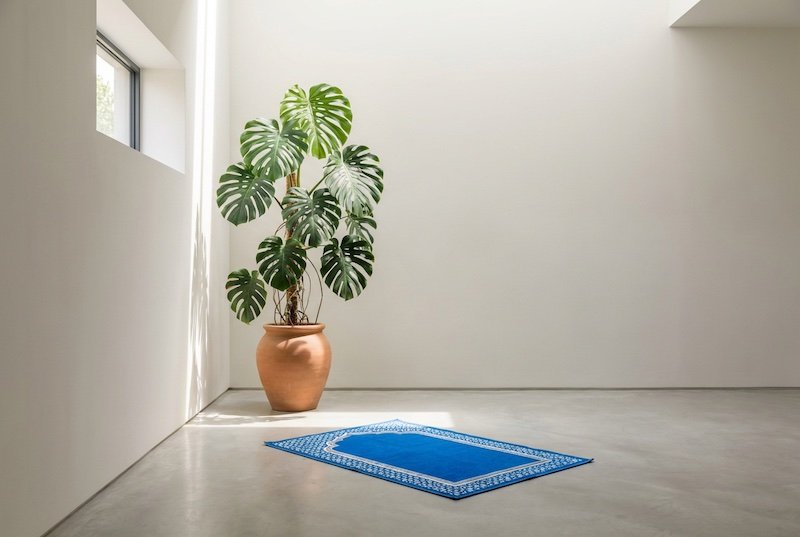
Why “Muslim Prayer Rug” Is the Wholesale Term You Are Ignoring
Ask most wholesalers what they sell and they will say muslim prayer rug wholesale stock without hesitation. Ask them whether their catalog, their product listings, and their B2B communications actually use the phrase “prayer rug” — and most will pause. They use “prayer mat.” They have always used “prayer mat.” And that one vocabulary choice is quietly costing them traffic, inquiries, and margin from a market segment that represents tens of millions of buyers in North America and Western Europe.
This is not a branding debate. It is a demand signal problem. And once you understand it, you will look at your inventory differently.
The Term Split: Who Says What and Why It Matters
In the Muslim world — Indonesia, Malaysia, the Gulf states, South Asia — “prayer mat” or its local equivalent is the standard term. In English-speaking Western countries with large Muslim communities — the United States, Canada, the UK, Australia — “prayer rug” is the phrase consumers type into search bars, ask about in retail stores, and use in community group chats. The two terms describe the same product. But wholesale buyers sourcing for these Western markets actively search for “muslim prayer rug” and frequently find sparse results because most suppliers default to “mat.”
The implication: if your product pages, your trade catalog PDFs, and your sales rep pitches do not include the phrase “prayer rug” alongside “prayer mat,” you are invisible to a meaningful portion of the demand side.
Where the Margin Opportunity Lives
Western Islamic retail, particularly in the US and UK, carries prayer rugs at retail price points that are 30–60% higher than comparable products sold in Southeast Asian or Middle Eastern markets. The aesthetic expectations are also different. Western Muslim consumers trend toward cleaner, more minimalist designs — neutral palettes, thicker pile, presentation packaging. A product that retails for $18–22 in Indonesia can retail for $35–48 in a US Islamic goods boutique or on an English-language e-commerce platform.
For the wholesale buyer sourcing those products, this means the margins support a higher landed cost — and thus a higher FOB price from you. If you are currently pricing your prayer mats purely against Southeast Asian market norms, you may be underselling the exact products that Western wholesalers would pay a premium for.
What Western Wholesale Buyers Prioritize
Conversations with importers supplying UK, US, and Canadian retailers surface a consistent set of priorities that differ from institutional or bulk commodity buyers. Packaging matters significantly — clean poly bags, printed inner boxes, or gift-ready presentation options. GSM is specified more precisely; 1,200–1,500 GSM is often described as the “feel” target. Country of origin documentation is nearly always requested. And aesthetic consistency across a range — meaning designs that coordinate rather than clash — is something Western retail buyers specifically ask for when building a shelf set.
None of this is beyond reach for a well-organized manufacturer or distributor. It is largely a matter of packaging upgrades and range curation. The challenge is knowing the demand exists in the first place.
The Naming Strategy in Practice
If you source or manufacture prayer supplies, the practical adjustment is straightforward. Audit every customer-facing touchpoint — product listings, catalogs, email templates, trade show signage — and ensure both terms appear. “Muslim prayer rug” and “prayer mat” are not competing; they are complementary. A buyer searching for either should land on your materials.
Beyond search optimization, consider framing in your sales pitches to Western-market buyers. Instead of presenting your product as a “prayer mat for daily use,” lead with “muslim prayer rug, gift-ready packaging available, 1,200 GSM, MOQ 200 units.” That language matches the mental model and vocabulary of the buyer you are trying to reach. The product is identical. The framing is doing meaningful commercial work.
One Category, Multiple Market Segments
What makes prayer rugs a particularly interesting wholesale category is that a single factory SKU can serve radically different end markets with minor adjustments. The same 60 × 110 cm velvet mat with foam backing ships to an Indonesian retailer under one label and to a UK gift shop under a completely different presentation — different packaging, different pricing, different terminology — yet the core product is the same. Wholesalers who recognize this and build sourcing relationships that allow flexible labeling and packaging are positioned to serve multiple markets simultaneously without manufacturing complexity.
FAQ
Is there a difference between a prayer mat and a prayer rug?
No functional difference. Both refer to the same product used during Islamic prayer. “Prayer rug” is the dominant term in Western English-speaking markets; “prayer mat” is more common in Muslim-majority countries.
What is the typical wholesale MOQ for Muslim prayer rugs?
MOQs vary by manufacturer, but 100–300 units per SKU is common for standard designs. Custom designs or packaging typically require 300–500 units minimum.
What packaging do Western retail buyers usually request?
Individual poly bags are the minimum. Many Western retailers prefer printed inner boxes or shrink-wrapped presentation packaging. Some gift-market buyers request ribbon or tassel accessories included.
The Takeaway
The global prayer rug market is not one market — it is several, segmented by region, vocabulary, aesthetic preference, and price sensitivity. Wholesalers who only optimize for the highest-volume segment leave margin on the table in segments where demand is real and competition is thinner. “Muslim prayer rug wholesale” is not just a keyword. It is a door into a market where your current inventory may already be exactly what buyers are looking for — they just cannot find you yet.