
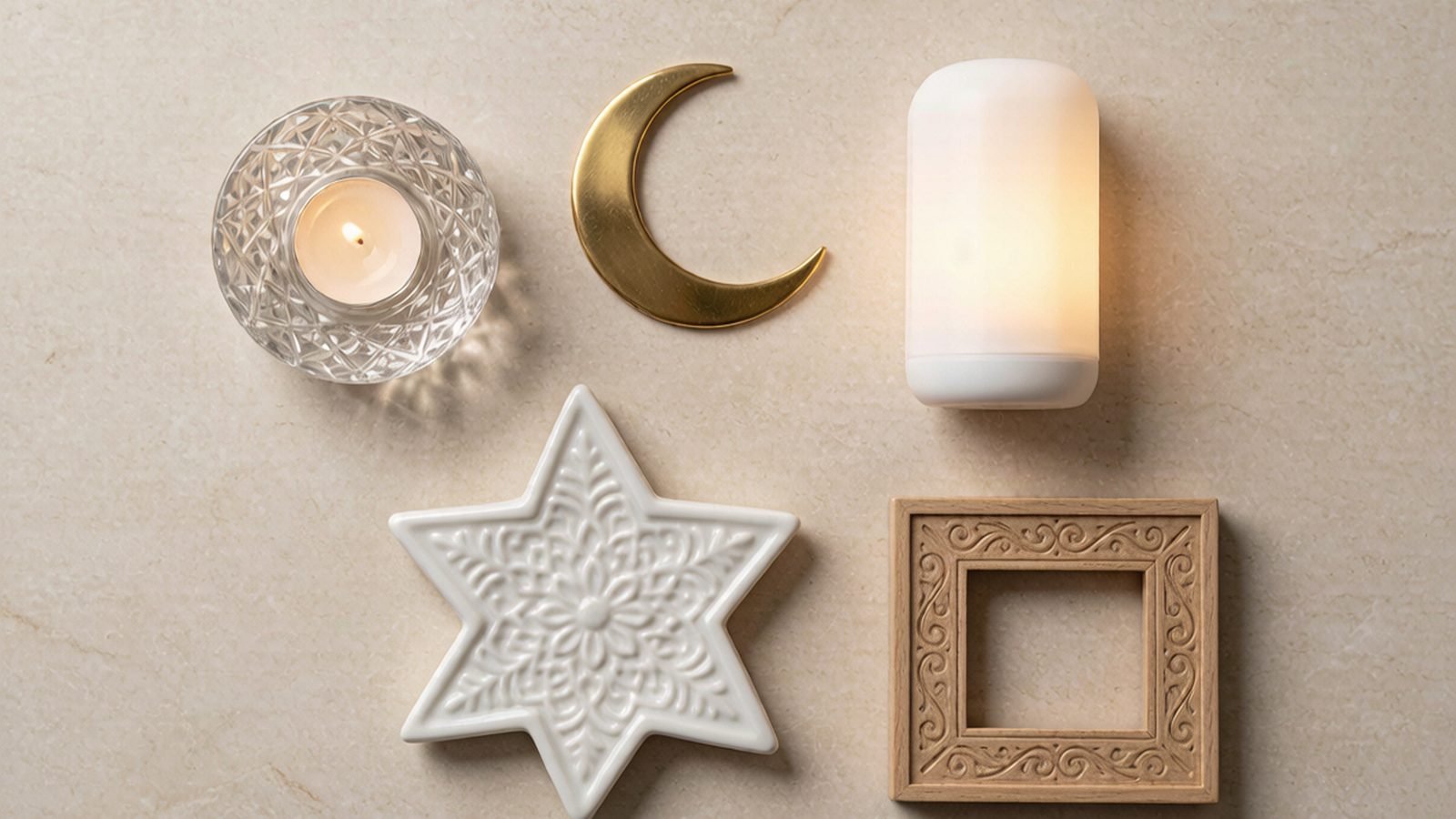
Islamic decorative ornaments sit in a comfortable sweet spot for wholesale buyers. They are small, they ship cheaply, they gift well, and they sell across almost every season of the Muslim calendar. But “ornaments” is a loose label, and the difference between a line that repeats and one that gets returned often comes down to materials and finishing. This deep dive looks at what actually goes into the category, how the materials behave, and which specs wholesale buyers should lock in before they commit.
What the Category Really Covers
When buyers talk about Islamic crafts and decor, they are usually mixing three very different product families. The first is glass and crystal lighting pieces — tea-light holders, lanterns, and LED night lamps. The second is wall and table ornaments — crescent and star wall hangings, engraved frames, ceramic stars. The third is functional giftware that happens to be decorative, such as prayer-time clocks and framed calligraphy. Each family has its own material logic, its own breakage risk, and its own margin profile, so treating them as one bucket is the first mistake a buyer can make.
Glass, Crystal, and the Clarity Question
Cut crystal and molded glass look similar on a listing photo but behave nothing alike in the warehouse. Lead-free crystal catches light with sharper refraction and feels heavier, which reads as premium at retail. Molded soda-lime glass is cheaper and lighter but scratches and clouds more easily. For wholesale, the spec that matters most is not “is it crystal” but “how thick is the wall and how is the base finished.” A thick, polished base resists chipping in transit; a thin poured base is where most breakage starts.
Metals: Plating Versus Solid
The crescent moon wall hanging and small lantern frames are typically either solid brass, aluminum alloy, or plated zinc. Solid brass ages beautifully and survives handling, but it is the most expensive by weight. Aluminum alloy is light and corrosion-resistant, ideal for pieces that ship long distances. Plated zinc is the budget option, and here the finishing layer is everything: a thin or uneven plating will rub through at the edges within months, which is the single most common complaint on low-cost decor. Buyers should specify plating thickness in microns and ask for an edge-wear test before a full container.
Ceramic and Resin: The Weight Trade-Off
Star-shaped ornaments and small decorative frames split between ceramic and resin. Ceramic feels authentic and carries finer surface detail, but it is heavier and more fragile per unit. Resin is nearly unbreakable in normal handling and far lighter to ship, at the cost of a slightly less premium tactile feel. For gift boxes and impulse displays, resin earns its place; for keepsake pieces meant to last, ceramic still wins. The right call depends entirely on the shelf life you are promising the end customer.
LED and Electronics: The Hidden Failure Mode
Ramadan night lamps and LED tea-light units add a small electronics layer, and that is where wholesale decor quietly fails. The weak points are the battery housing, the switch, and the glue holding the diffuser. A unit that works on arrival but dies in six weeks is worse than one that never shipped. Specify sealed battery compartments, rated switches, and a sample burn-in of at least 72 hours. It is a cheap test that prevents a whole season of refund requests.
Surface Finishing and Color Stability
Color is where ornaments live or die on the shelf. Painted and printed finishes fade under window light and rub off on hands; anodized, dyed-through, or fired finishes hold. For anything meant to sit in a sunlit shop window, insist on UV-stable finishes and request a fade sample. The same logic applies to gold and rose-gold tones: a fired or anodized tone stays; a surface paint drifts to brass-green within a season.
Specs to Lock Before You Order
A short, non-negotiable spec sheet saves more money than any unit-price negotiation. Pin down base material and wall thickness for glass, plating microns and edge-wear test for metal, material choice and breakage rate for ceramic versus resin, and burn-in proof for anything with a battery. Pair these with the prayer supplies you already carry, and ornaments become a natural add-on that lifts average order value without adding a new supplier relationship.
FAQ
Which ornament material breaks least in transit?
Resin-based pieces and aluminum-alloy frames are the most transit-resistant. Glass and ceramic need thicker walls and molded inserts, but they still carry higher damage rates than resin.
Is lead-free crystal worth the higher cost?
For a premium retail shelf, yes — the weight and light return justify the price. For high-volume impulse bins, molded glass performs well enough at a fraction of the cost.
How do I avoid faded finishes?
Specify UV-stable or fired finishes for anything displayed in daylight, and request a fade sample before committing to a full production run.
Summary
Islamic ornaments reward buyers who spec by material rather than by photo. Separate the glass, metal, ceramic, resin, and electronic families, set a finish and durability standard for each, and the category shifts from a breakage risk into one of the steadiest, highest-margin impulse lines in the whole catalog.