
7 Things Mosque Buyers Check Before Ordering Prayer Mats in Bulk
Sourcing prayer mats for mosque use is nothing like restocking a retail shelf. A mosque committee or Islamic center procurement officer is not browsing a catalog the way an individual consumer does. They are responsible for hundreds or thousands of worshippers, and every product decision carries weight — practically and symbolically. Getting it wrong does not just mean a slow seller. It means complaints, durability failures, and a supplier relationship that ends after one order.
If you are a wholesaler or distributor hoping to win mosque and institutional accounts, understanding exactly what these buyers evaluate will change how you present your products. Here are the seven criteria that come up again and again in mosque procurement conversations.
1. Uniform Dimensions That Cover Standard Row Spacing
Most mosques arrange prayer mats in neat rows aligned to the qibla direction. The standard individual mat is 60 × 110 cm, but mosque buyers often prefer slightly longer mats — 65 × 115 cm or even 70 × 120 cm — to give each worshipper adequate space without crowding the person in front. Some larger mosques request roll-out carpet strips instead of individual mats for continuous row coverage. If your product line only offers one size, you are immediately at a disadvantage.
2. Non-Slip Backing That Works on Marble and Tile
Most mosques have hard flooring — polished marble, ceramic tile, or terrazzo. A mat that slides under foot traffic is not just inconvenient; it is a safety issue. Mosque buyers specifically ask about the backing material. Rubberized non-slip backings hold up well, but check whether the rubber off-gasses odor over time — a consistent complaint in warm climates. Anti-slip latex coatings are another option, though they can crack after repeated washing. Ask your factory for a cold-temperature flex test if the mats will go to buyers in Northern Europe or North America.
3. Colorfastness After Commercial Laundering
Mosque prayer mats are washed far more frequently than household mats — some facilities wash weekly, others after each Jumu’ah. Standard domestic wash tests are not sufficient here. Buyers want to know that colors hold through 50 or more commercial wash cycles. If you can supply ISO 105-C06 or equivalent colorfastness test results from a third-party lab, it will set you apart from suppliers who only quote verbal guarantees. A mat that fades to a washed-out grey after three months is going to generate complaints — and those complaints travel fast within mosque networks.
4. No Odor — Especially in Humid Climates
This is raised almost universally by buyers from Southeast Asia, the Gulf region, and West Africa. Mosques are densely occupied spaces with limited ventilation during prayer times. Any synthetic backing material or pile fiber that retains moisture and off-gasses can make the prayer space uncomfortable within weeks of installation. Ask your supplier about anti-bacterial treatments and moisture-wicking pile options. Natural fiber content — cotton or wool blends — generally performs better in humid climates, though at a higher price point.
5. Design Neutrality and Absence of Figurative Imagery
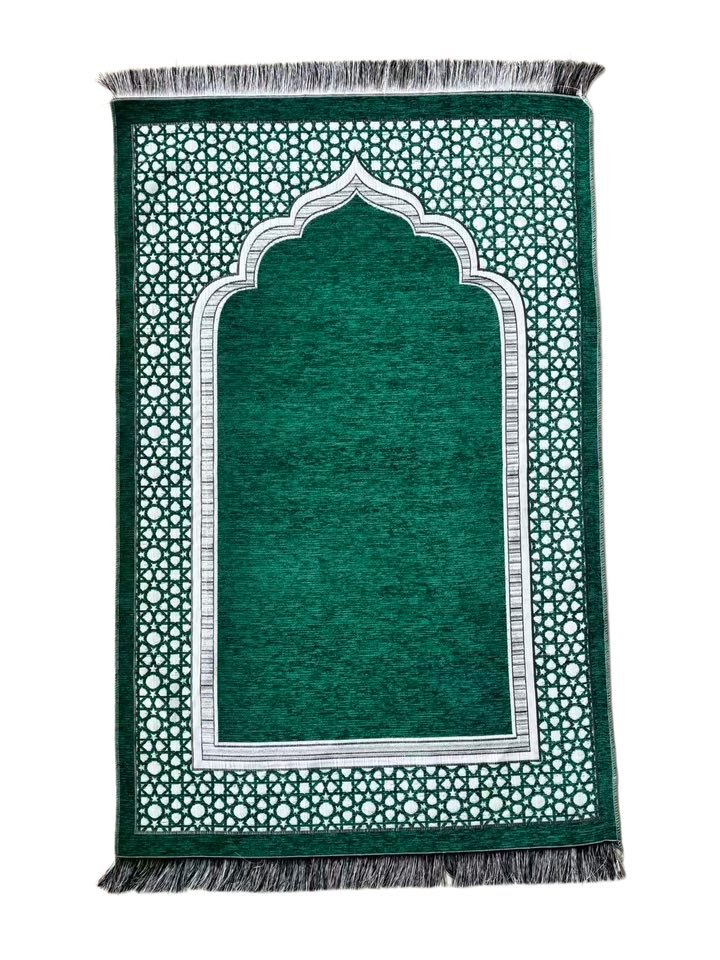
Mosque committees are conservative on this point. Geometric mihrab motifs and simple border patterns are universally accepted. Floral patterns are generally fine but occasionally questioned by stricter committees. Any figurative or calligraphic designs require approval from the mosque’s religious authority. The safest catalog position for institutional sales is a range of clean geometric designs in neutral tones — dark green, burgundy, navy, beige — with optional custom color matching for larger orders.
6. Minimum Order Quantities That Match Institutional Needs
A small mosque may need 100–200 mats. A large Islamic center or university mosque can need 2,000 or more. The frustrating scenario for institutional buyers is a supplier whose MOQ sits at 500 units in one size and one color — not useful when they need 300 of one size and 150 of another. Flexible MOQs by SKU, or the ability to mix sizes within a single order, are a genuine competitive advantage when targeting mosque accounts. Pair this with a clear lead time commitment and you resolve the two most common institutional objections upfront.
7. Documentation: Certifications, Material Declarations, and Country of Origin
Many mosque procurement processes — especially in government-affiliated institutions in Malaysia, Saudi Arabia, and the UAE — require formal documentation before a purchase order can be raised. This includes material composition declarations, country of origin certificates, and sometimes Halal certification for any chemical treatments used in manufacturing. Having these documents ready — not “available upon request” — signals that you operate at a professional level and have institutional clients already. It removes friction from the purchasing process and speeds up approval cycles.
FAQ
What is the standard size for a mosque prayer mat?
Individual mosque mats typically range from 60 × 110 cm to 70 × 120 cm. Some mosques prefer continuous roll carpets for row coverage rather than individual mats.
Can mosque prayer mats be customized with the mosque’s name or logo?
Yes, many factories offer custom embroidery or woven name borders for orders above a certain quantity, typically 300–500 units. Lead times are longer — budget 60–90 days for custom production runs.
What certifications do mosque buyers typically ask for?
Common requests include OEKO-TEX for chemical safety, ISO colorfastness test results, and material composition declarations. Government-linked institutions may also require Halal certification on any chemical finishes.
Final Thought
Mosque and institutional accounts are slower to acquire than retail buyers, but they are far more loyal. A mosque committee that finds a reliable supplier for prayer supplies does not switch easily — the administrative effort alone discourages it. If you can meet the seven criteria above and demonstrate that your operation handles institutional documentation professionally, you are positioning yourself in a segment of the market where margins are better and repeat orders are predictable. That is a worthwhile investment in your product specification and sales approach.