
So You Think Decorative Ornaments Are Just “Nice to Have”? Think Again
If you run an Islamic goods store and you are treating decorative ornaments as an afterthought — something you order a few dozen of, toss into a clearance bin near the counter, and never think about again — you are leaving real money on the table. Not pocket change. The kind of margin that makes your accountant raise an eyebrow.
I know because I have watched retailers make this exact mistake. They pour their budget into prayer mats and hijabs, then wonder why a competitor down the street — who stocks half the SKUs but sells Islamic decorative ornaments by the carton — is somehow running a healthier business. The math is not complicated when you look at it.
The reason decorative ornaments work so well in this market is simple: nobody budgets for them, but everybody buys them. A customer walks into your store for a prayer mat. They leave with the mat, plus a brass crescent moon wall hanging, two calligraphy coasters, and a geometric lantern. None of those were on the shopping list. They were impulse purchases triggered by visual appeal and a price point under ten dollars. Multiply that by a hundred customers a week, and you start to see why the “clearance bin” mentality is costing you.
What Actually Sells: The Ornament Categories Worth Your Shelf Space
Not all decorative ornaments are created equal. Some gather dust. Some disappear within days of being unboxed. After talking to retailers across Southeast Asia, the Middle East, and European Muslim communities, three categories consistently dominate.
Wall-hanging metal ornaments — brass, copper, or powder-coated iron with laser-cut arabesque patterns — are the heavy hitters. These range from 15 cm crescents to 40 cm geometric mandalas. At wholesale prices between $2 and $8, they retail at $8 to $25. The margin is generous, and the perceived value is high because they look expensive. A well-placed wall hanging in your store window will pull people in. Retailers in Saudi Arabia and the UAE report that large geometric designs outsell Arabic calligraphy pieces nearly two to one, while European markets lean toward minimalist crescent designs in matte black or gold.
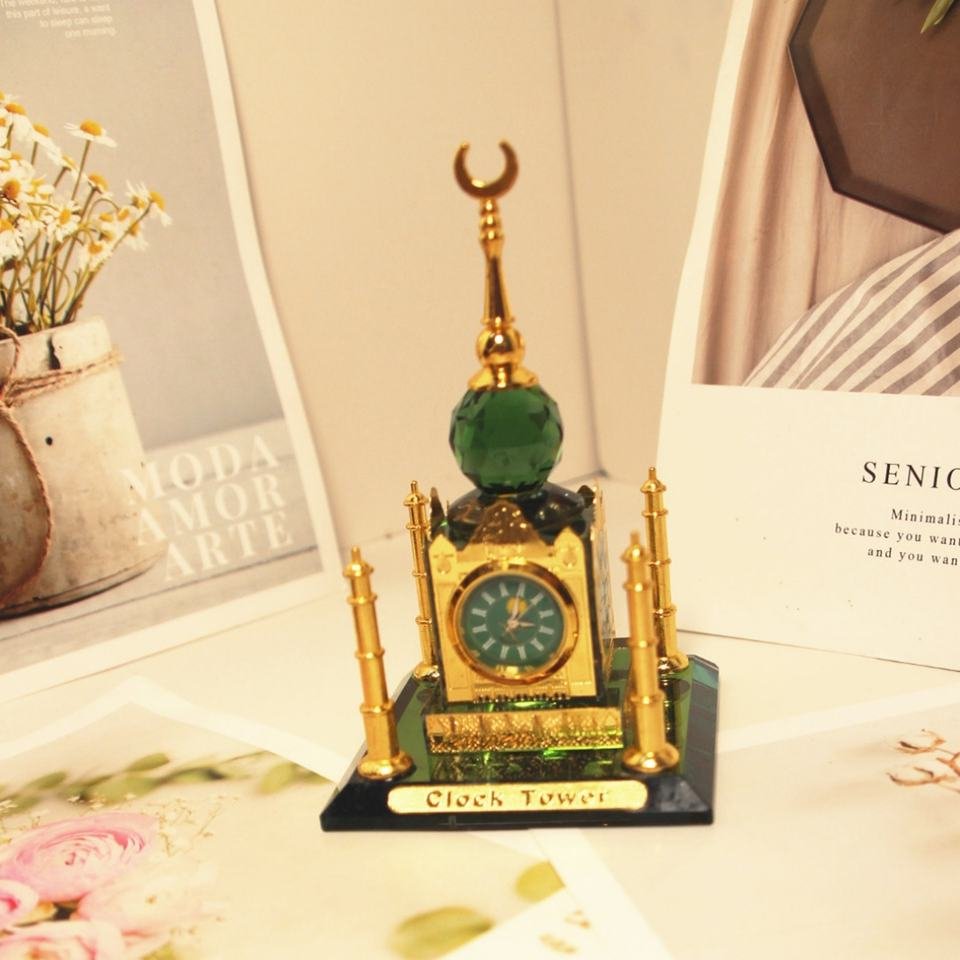
Tabletop ornaments and figurines are the second category, and this one surprises people. We are talking about resin or ceramic mosque replicas, miniature lanterns, decorative Quran stands, and 3D-printed Arabic calligraphy pieces. These sit on shelves, desks, or mantels. The wholesale sweet spot here is $3 to $12. Indonesian retailers have had particular success with wooden mosque models carved from jati or mahogany — they appeal to both local customers and tourists. European Muslims tend to prefer sleek, minimalist tabletop pieces in neutral tones, while Middle Eastern buyers gravitate toward gold-accented and jewel-toned resin ornaments.
Hanging ornaments and mobiles round out the trio. Think Ramadan string decorations, star-and-crescent mobiles for nurseries, Eid tree ornaments, and fabric bunting with Islamic motifs. This category is seasonal but explosive. A Dubai-based retailer told me they sell more hanging ornaments during the two weeks before Ramadan than they sell prayer mats in an entire quarter. The key is ordering early — by the time Ramadan marketing kicks in, your supplier has already allocated inventory to the retailers who placed orders in October.
The Material Question Nobody Asks Until It Is Too Late
Here is a conversation I have had with at least five different importers. It goes something like this:
“The samples looked great.”
“And then?”
“The bulk order showed up and half the metal ornaments had rust spots. The resin pieces had air bubbles. The wooden ones had cracks I could fit a credit card through.”
Material quality is where wholesale decorative ornaments either become a profit center or a write-off. Metal ornaments — especially those destined for humid climates like Malaysia or Indonesia — need protective coating. Not the thin spray-on lacquer that rubs off in shipping. Electroplated or powder-coated finishes. When you are ordering brass or copper ornaments, specify anti-tarnish treatment in your purchase order. It adds maybe $0.30 per unit. It saves you an entire shipment from the landfill.
For resin ornaments, the issue is air bubbles and uneven coloring. These are manufacturing defects caused by rushed curing or poor mold design. You catch them by requesting pre-production samples — not the polished showroom samples your supplier wants to send, but pieces pulled randomly from the last production run. If the supplier hesitates, reconsider the relationship.
Wooden ornaments need to be kiln-dried. This is non-negotiable. Wood that has not been properly dried will crack, warp, or grow mold within weeks of arriving in your warehouse. The moisture content should be below 12% for tropical climates and below 10% for arid ones. Ask your supplier for a moisture content certificate. If they cannot provide one, find a supplier who can.
Where Your Competitors Source — And Where You Should Too
The global supply chain for Islamic decorative ornaments is concentrated in a few places. China’s Yiwu market remains the dominant source for metal, resin, and mass-produced ornaments — the price is hard to beat, and the logistics infrastructure is mature. But Turkey has carved out a premium niche in handcrafted copper and brass ornaments with authentic Ottoman motifs. These pieces wholesale at $10 to $30 and retail at $30 to $80, targeting the high-end market in London, Paris, and Dubai.
India and Pakistan are strong sources for carved wood ornaments and embroidered fabric decorations — especially Ramadan bunting and Eid-themed hangings. Morocco specializes in zellige-inspired geometric pieces and intricately cut metal lanterns, though production volumes tend to be smaller and lead times longer.
A smart sourcing strategy for a mid-sized wholesale decorative ornaments buyer often combines two or three origins. Yiwu for the volume SKUs at competitive prices, Turkey or Morocco for a curated premium line that differentiates your catalog, and India for seasonal fabric decorations. The key is not to put all your eggs in one supply chain — shipping delays, tariff changes, and quality fluctuations are real, and a diversified supplier base is your insurance policy.
The Pricing Sweet Spot Most Importers Miss
There is a psychological threshold in Islamic decorative ornament pricing that I rarely see discussed openly. The impulse-buy ceiling is roughly $15 retail. Above that, the customer starts thinking. Below that, they just add it to the basket. Your wholesale cost for ornaments intended to sell under $15 should therefore be $3 to $6.
But here is the counterintuitive part: you also need the $25 to $40 retail ornaments. Not to sell at volume — you will sell far fewer of them — but to anchor perception. When a customer sees a $35 hand-engraved brass crescent next to a $12 laser-cut version, the $12 piece looks like a bargain. Without the anchor, the $12 piece looks expensive. This is basic behavioral economics, and it works every time.
Your ornamental product mix should be roughly 60% impulse-buy (<$15 retail), 25% mid-range ($15-$30), and 15% premium ($30+). The premium tier subsidizes your brand perception. The impulse tier generates your cash flow. The mid-range catches the customer who wants something "a little nicer" than the impulse pieces but is not ready to drop $40 on an ornament.
Frequently Asked Questions
Q: How many SKUs of decorative ornaments should a new store start with?
Start with 30 to 40 SKUs across the three categories — wall hangings, tabletop ornaments, and hanging decorations. Focus 60% of those on the impulse-buy price range. Expand your premium selection once you understand what your specific customer base responds to.
Q: Are there religious considerations when selecting ornamental designs?
Avoid depictions of living beings (humans, animals) — this is important for many Muslim customers. Stick to geometric patterns, arabesque motifs, calligraphy, crescent moons, stars, and architectural themes. These are universally accepted and sell across all demographics.
Q: How do I protect fragile ornaments during international shipping?
Resin and ceramic ornaments need individual foam wrapping plus partitioned inner cartons. Metal ornaments should be separated by foam sheets to prevent scratching. Wooden pieces need silica gel packets to control humidity. Budget 8% to 12% of your order value for adequate packaging — it is cheaper than a 30% breakage rate.
Stop Treating Ornaments Like Side Inventory
The retailers who do well with Islamic decorative ornaments are not the ones with the biggest stores or the deepest pockets. They are the ones who treat this category with the same seriousness they give to their core product lines. They source strategically, they understand materials, they protect shipments, and they design their pricing psychology deliberately.
Your prayer mats and hijabs get people through the door. But your ornaments — those little brass crescents and carved wooden domes that nobody came in to buy — are what turn a five-dollar transaction into a twenty-five-dollar transaction. Over and over again. Pay attention to what they are telling you.