
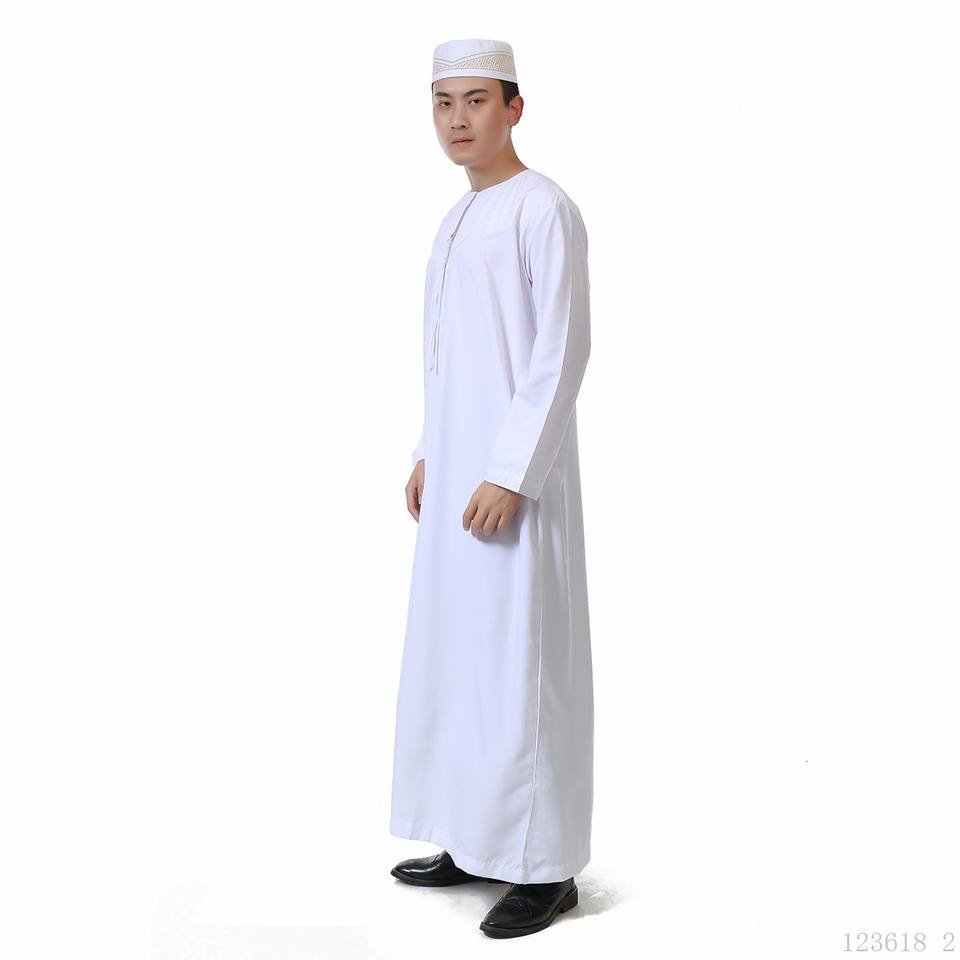
Ordering thobes in bulk sounds simple until the container arrives and half the sizes run small for your Gulf buyers while the collar style your Southeast Asian customers wanted is nowhere on the spec sheet. The thobe — also called thawb, kandura, or dishdasha depending on the market — is one of the most regionally sensitive garments in Islamic menswear. What sells in Riyadh does not necessarily sell in Jakarta. Before you commit to a production run, here are seven checks that separate wholesalers who reorder from those who liquidate.
1. Fabric Weight Must Match the Destination Climate
The same thobe design ships in fabric weights ranging from 120 GSM summer poplin to 250 GSM winter blends. Gulf markets — Saudi Arabia, UAE, Qatar — overwhelmingly demand lightweight polyester-poplin at 130-150 GSM for year-round wear. Southeast Asian buyers often prefer cotton-rich blends at 160-180 GSM because the fabric absorbs moisture better in humid climates. Ordering 250 GSM winter stock for a Jakarta retail chain is a mistake that shows up as clearance discounts within three months.
2. Collar Style Signals Which Market You Are Targeting
The collar is the single most visible differentiator between thobe styles. A tuxedo collar with buttons down the front is standard for Saudi and Emirati markets. A Mandarin (band) collar is preferred in South Asian and some African markets. A shirt-style collar with a zip front appeals to younger Southeast Asian consumers. Mixing collar styles across an order without clear SKU labeling is the fastest way to create inventory confusion at the retail level. Specify collar type per SKU and confirm samples before production.
3. Sizing Standards Are Not Universal
Gulf thobe sizing follows a shoulder-based system measured in inches (52, 54, 56), while Southeast Asian sizing often follows chest circumference in centimeters. A size 54 thobe from a Gulf-pattern factory does not match a “54” from an Indonesian-pattern factory — the difference can be 6-8 cm in actual chest measurement. Request a measurement chart from your supplier that lists shoulder, chest, sleeve length, and total garment length for each size. Cross-reference against your destination market’s standard before approving samples.
4. Stitch Density at Stress Points Determines Return Rates
The cuff, the collar attachment, and the side slit are the three points where thobes fail under repeated wear. A stitch density of 10-12 stitches per inch at these points is the baseline for acceptable quality. Anything below 8 SPI will show seam separation within 15-20 wash cycles. Ask your supplier to specify SPI at stress points — not just the main body seam — and request a wash-test report on at least one sample before committing to volume.
5. Placket and Button Construction Affects Perceived Value
The front placket — the reinforced strip where buttons or snaps attach — is what separates a premium thobe from a budget one. Heat-fused interfacing inside the placket prevents wrinkling and bubbling after washing. Thin or missing interfacing results in a placket that warps after three washes, making the entire garment look cheap even if the fabric is good quality. Snap buttons (press studs) are increasingly popular over sewn buttons for convenience, but they must be rust-resistant — specify stainless steel or coated brass.
6. Color Fastness Is Non-Negotiable for White Thobes
White is the dominant thobe color across all markets, and white fabric that yellows after 5-6 washes is the number one complaint from retail customers. Request a color fastness rating of at least grade 4 (on the ISO 105-A02 scale) for both washing and light exposure. Suppliers who cannot provide this rating are likely using untreated greige fabric that will fail in the field. For colored thobes — navy, grey, beige — the same standard applies, with additional attention to crocking (rub fastness) grade 4 or above.
7. MOQ Flexibility Determines Your SKU Breadth
Most men’s Islamic wear suppliers set MOQ at 300-500 units per SKU for standard designs and 500-1,000 for custom embroidery or specialized fabric. If you are building a retail assortment across multiple sizes and collar styles, the total commitment adds up quickly. Negotiate tiered MOQs: full MOQ for your top-selling size and collar combination, and 50-70% MOQ for secondary SKUs. Suppliers who agree to this structure are thinking long-term partnership, not one-time transaction.
FAQ
What is the difference between a thobe and a kandura?
They are the same garment. “Thobe” (or thawb) is the generic Arabic term. “Kandura” is the specific term used in the UAE. “Dishdasha” is used in Oman. The garment is a full-length robe with long sleeves, typically white, worn by Muslim men.
What MOQ should I expect for custom thobe orders?
Standard designs typically require 300-500 units per SKU. Custom embroidery, specialized fabric, or unique collar construction usually raises MOQ to 500-1,000 units. Some suppliers offer lower MOQs (100-200) for first-time trial orders.
Are thobes only white?
No. While white dominates Gulf markets, darker colors — navy, charcoal, olive, beige — are common in winter collections and in South Asian and African markets. Some Southeast Asian retailers stock pastel shades for younger consumers.
Conclusion
Thobes are not a commodity you can source blindly and expect consistent sell-through. The garment’s regional specificity — in collar style, sizing system, fabric weight, and color expectations — means that every bulk order must be tailored to a defined destination market. Run through these seven checks before signing off on production, and you will avoid the inventory mismatches that sink margins. The men’s collection category rewards wholesalers who understand these nuances with repeat orders, lower return rates, and the kind of supplier relationship that opens doors to exclusive designs and priority production slots during peak season.