
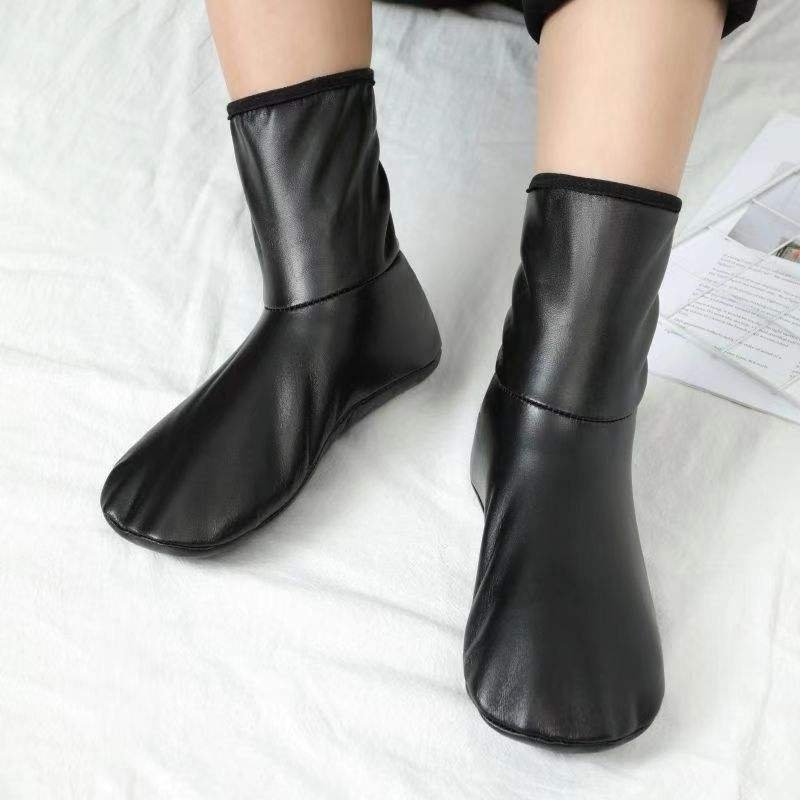
You have probably skimmed past khuff prayer socks in a supplier catalog and filed them under “generic hosiery.” Small item, low price, nothing complicated. Then you order 1,000 pairs, ship them to three markets, and within a month your inbox fills up. The leather cracks after two washes. The zipper corrodes. The thermal lining sheds inside the shoe. The size chart was built for Pakistani feet and your Indonesian buyers are returning half the order.
Khuffain are not socks in the fashion sense. They are ritual footwear — worn during prayer, during wudu, and in some madhhab traditions, considered a permissible substitute for washing the feet. That functional requirement changes everything about how they should be sourced. Here is what experienced wholesale buyers have learned, and what you should ask before your next bulk order.
“Leather” Is Not One Word — It Is Four Different Products
Your supplier says “leather khuff.” But which leather? Full-grain cowhide — the premium tier, durable for 2–3 years of daily use, costs 3–4x more than the alternatives. Sheepskin — softer, lighter, ideal for winter thermal lines, but wears faster. Split leather — the mid-market compromise, looks like full-grain from the outside but delaminates after repeated moisture exposure. And then there is PU-coated faux leather — technically not leather at all, but marketed as such. Each material serves a different price tier and a different buyer. If your supplier cannot tell you which one they are using, you are buying a mystery.
The Zipper Question Nobody Asks Until Returns Start
Many khuff designs use a side zipper for easy on-off. Smart feature. But the zipper is the first failure point on nearly every return. A YKK zipper costs the supplier roughly 3–5x more than a generic Chinese alternative, and the difference shows up in 4–6 months of use — not on day one. Ask your supplier what brand zipper they use. If they say “standard” or “OEM,” you are getting the cheap one. For premium retail channels, insist on YKK or SBS. For budget channels where the khuff is treated as semi-disposable, the generic may be acceptable — but price it accordingly.
Thermal Lining: The Winter Market Is Bigger Than You Think
Thermal khuff socks with self-heating or fleece lining are not a niche product. They are the primary driver of winter-season Islamic footwear sales in Turkey, Central Asia, Northern Europe, and North America. The self-heating variant uses a thermal-reflective inner coating that traps body heat — effective but adds 20–30% to unit cost. Fleece lining is cheaper, warmer, but bulkier inside the shoe. The mistake wholesalers make is ordering one lining type for all markets. A buyer in Dubai does not need thermal lining. A buyer in Berlin absolutely does.
Size Charts: The Hidden Reason for 30% Return Rates
Khuff sizing is not standardized globally. Pakistani manufacturers use a size chart that runs 1–2 sizes smaller than Turkish or Indonesian expectations. Chinese factories often default to EU sizing. If you are sourcing khuff from a Pakistani supplier and selling to Southeast Asian buyers, you need to either: (a) request a custom size chart matched to your target market, or (b) print a conversion table on the packaging. Option (a) costs nothing if you ask before production starts. Option (b) costs a small printing fee but saves you thousands in return shipping.
Women’s Khuff: A Separate Product, Not a Smaller Men’s Khuff
Women’s prayer khuffain are not just smaller versions of men’s models. The ankle shape is different, the arch support requirement is different, and the aesthetic expectations are completely different — women’s khuff often incorporate faux leather with decorative stitching or subtle color variations. The zipper placement is also lower. Wholesalers who try to serve the women’s market with downsized men’s SKUs consistently underperform. If you are carrying women’s khuff, source them as a distinct product line with their own fit testing.
The Wudu Test: Your Real Quality Benchmark
Here is a test most wholesalers never run but should. Take a sample khuff, wear it during wudu (the ritual ablution), and check three things: Does water penetrate through the material within 15 seconds? Does the interior lining stay dry? Does the material leave any residue or color bleed on the skin? A khuff that fails any of these three checks is not fit for purpose — no matter how good it looks in the catalog. This test costs you five minutes and one sample. It can save you from a 2,000-unit order that generates a 40% return rate.
FAQ
What is the difference between khuff and khuffain?
Khuff (خف) is the singular form; khuffain (خفّين) is the dual form, referring to a pair. In wholesale sourcing, both terms refer to the same product category: leather or synthetic socks worn for prayer and wudu.
What is the typical MOQ for khuff wholesale?
MOQ for standard khuff designs usually starts at 300–500 pairs per SKU. Custom designs with specific leather types, lining options, or branding typically require 500–1,000 pairs minimum.
Can khuff be washed, and how does this affect sourcing?
Full-grain leather khuff can be wiped clean but should not be machine-washed. Faux leather variants are more wash-tolerant but have shorter lifespans. Always specify the intended care method with your supplier, as it affects material choice and construction method.
Conclusion
Khuff prayer socks are a deceptively complex product category. The buyer who treats them as generic hosiery will field complaints about zippers, sizing, and material degradation within one sales cycle. The buyer who understands the leather hierarchy, insists on named zipper brands, matches thermal lining to destination climate, requests market-specific size charts, separates women’s khuff as a distinct line, and runs a simple wudu test before committing to a bulk order — that buyer builds a reorder rate that turns a low-ticket item into a steady revenue stream. In khuff, the details are not details. They are the product.