
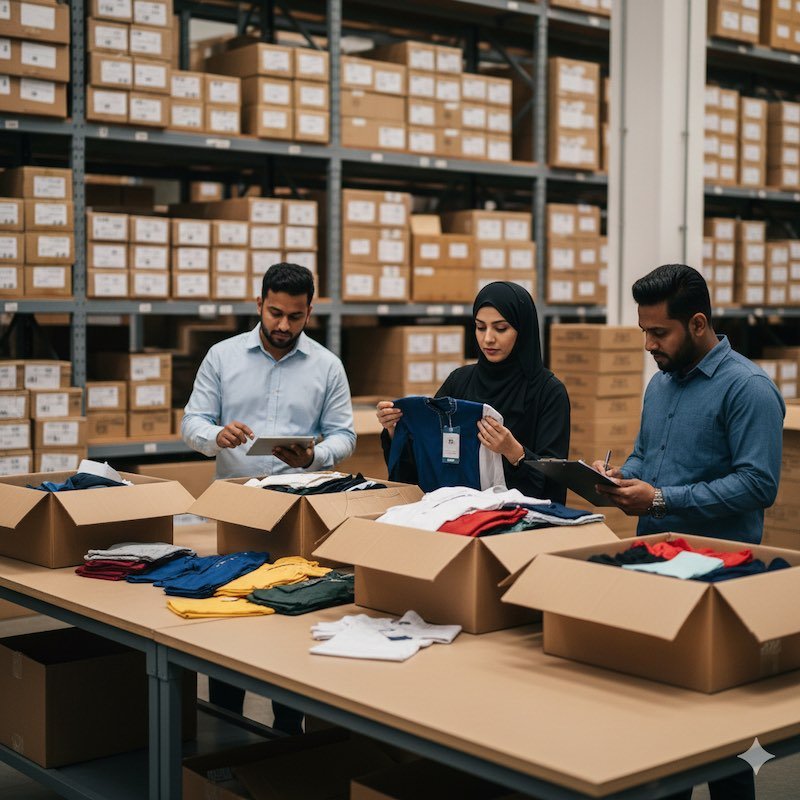
The Unseen Supply Chain: How Islamic Products Reach Your Warehouse
When a container of Islamic products wholesale goods arrives at a retailer’s loading dock, it looks unremarkable. A metal box with a shipping label. What is invisible is the extraordinary journey those products travelled — often crossing three continents, passing through customs regimes with varying halal requirements, and surviving logistics networks that were never designed for culturally specific goods. For wholesale buyers, understanding this supply chain is not academic. It is the difference between reliable inventory and a warehouse full of unsellable merchandise.
The Manufacturing Clusters Nobody Talks About
Prayer mats are not made in one place. The woven polyester mats common in Southeast Asian markets come predominantly from Zhejiang province in China, where textile mills have spent a decade refining the non-slip latex backing that prevents mats from sliding on tile floors. The velour prayer mats favoured in Middle Eastern markets, by contrast, often originate in Turkey’s Denizli region, where pile-weaving traditions go back centuries. Wholesale buyers who do not know which cluster produces which type end up paying middlemen for intelligence they could have gathered themselves.
The Certification Bottleneck
A shipment of halal-certified cosmetics leaving a factory in Guangdong does not simply sail to Indonesia. Before the container reaches a port, the product must carry certification from a body recognised by the destination country — BPJPH for Indonesia, JAKIM for Malaysia, or ESMA for the UAE. Each certification body has different testing protocols and documentation formats. Shipments routinely get held at customs for weeks because a certificate references an outdated lab report or uses terminology not recognised by the importing authority.
Experienced wholesale buyers build certification into their timeline from day one. They do not ask “can you ship next month?” — they ask “when will the certification dossier be ready, and which body issued it?”
The Consolidation Game
Most Islamic wholesale shipments are less-than-container-load (LCL). A buyer ordering tasbih from one factory, tasbih beads from a second, and kufi caps from a third cannot fill a 40-foot container with any single factory’s output. The goods must be trucked to a consolidation warehouse, combined with shipments from other buyers, and loaded into a shared container. Every consolidation point adds handling, and every handling event risks damage, loss, or mislabelling.
The buyers with the smoothest supply chains consolidate at source — they work with a single freight forwarder in the manufacturing region who collects goods from all their suppliers before the container ever reaches a port. It costs slightly more in logistics fees. It costs far less in damaged goods and missing inventory.
The Last-Mile Cultural Gap
Once the container clears the destination port, the product still has to reach retail shelves. In markets like Indonesia or Morocco, that often means small trucks navigating narrow streets to reach shops in traditional market districts. Delivery drivers who do not understand why a box labelled “Quran stands” cannot be placed on the floor alongside footwear create friction that shows up as product returns and retailer complaints.
Leading Islamic wholesale distributors now include handling instructions in the local language on every carton. A simple Arabic or Bahasa Indonesia label that says “handle with care — religious items” prevents more damage than a hundred layers of bubble wrap.
The Digital Layer That Changes Everything
The most underrated development in Islamic wholesale supply chains is not faster ships or bigger warehouses. It is track-and-trace technology. A retailer who can open a link and see exactly where their order is — from factory floor to port to customs clearance to local delivery — is a retailer who does not call you three times a week asking for updates. Wholesale buyers who invest in visibility tools reduce their customer service workload by an estimated 40 percent while increasing reorder rates.
The supply chain of an Islamic product is not just a logistical route. It is a trust chain. Every link that holds, strengthens the relationship between wholesaler and retailer. Every link that breaks, it costs money — and something harder to recover: credibility.
FAQ
How long does a typical Islamic wholesale supply chain take from order to delivery?
From purchase order to warehouse delivery, expect 45 to 75 days for sea freight from Asia to the Middle East or Southeast Asia. Air freight can cut that to 7 to 14 days but at 4 to 6 times the cost. The biggest variable is not transit time — it is customs clearance, which can add anywhere from 2 days to 3 weeks depending on documentation quality.
Should I use a sourcing agent or deal directly with factories?
For your first two or three orders, a sourcing agent is almost always worth the commission (typically 5 to 8 percent). They know which factories specialise in Islamic products, they understand certification requirements, and they can inspect goods before they leave the factory. Once you have established relationships and quality benchmarks, transitioning to direct factory relationships can improve your margins.
What is the most common supply chain mistake in Islamic wholesale?
Underestimating the importance of packaging. A shipment of beautifully crafted prayer beads that arrives in flimsy bulk cartons with no retail-ready packaging will sit in a retailer’s back room while competitors’ products move to the shelf immediately. The supply chain does not end at the warehouse door — it ends when the product is ready to sell.
Conclusion
The Islamic wholesale supply chain is not mysterious. It is just detailed. Every step — factory selection, certification, consolidation, transport, last-mile delivery — is a decision point where the buyer either gains control or loses it. The buyers who understand this build their businesses on supply chain competence, not just product selection. In a market where product quality is increasingly commoditised, the way products reach the shelf is becoming the real differentiator. Master the journey, and the destination takes care of itself.