
Source Tasbih by Material: The Wholesale Buyer’s Action Plan
Most wholesalers pick tasbih the way they pick produce — by look and feel. But unlike fruit, a prayer bead’s value lives in its material, not its appearance. Two tasbih that look identical side by side can have a 400% cost difference and radically different reorder rates. If you are sourcing without a material-first framework, you are buying blind. Here is the action plan experienced buyers follow.
Step 1: Map Your Material Tiers Before Contacting Suppliers
Before you send a single inquiry, draw three columns on a sheet of paper: entry-level, mid-range, and premium. Entry-level covers resin and plastic-based composites — your $0.30 to $1.20 per unit cost range, aimed at bulk giveaway and promotional channels. Mid-range is where wood tasbih lives: kokka wood, sandalwood, and rosewood, typically $1.50 to $4.50 per unit, serving daily-use retail. Premium covers natural stone — agate, black onyx, crystal quartz — at $5 to $15+ per unit, positioned for gifting and specialty retail. You need at least one SKU in each tier. Buyers who stock only one tier leave money on the table or lock themselves out of entire customer segments.
Step 2: Wood Tasbih — Verify Species, Not Just “Wood”
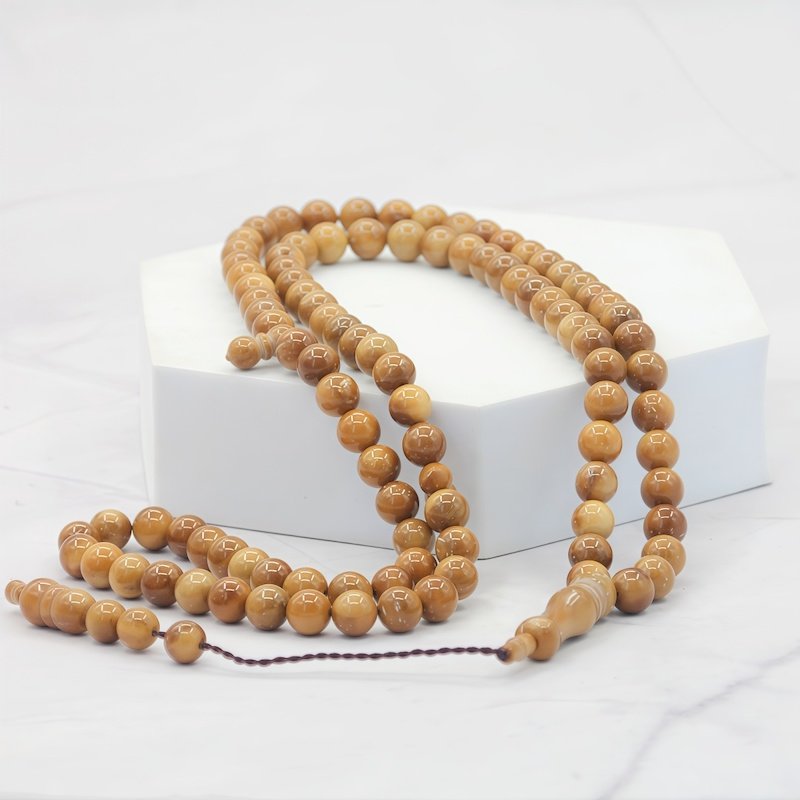
Suppliers routinely list tasbih as “wooden prayer beads” without specifying the species. This is a red flag. Kokka wood (from the jujube tree) is dense, finely grained, and naturally darkens with use — ideal for daily-wear tasbih. Sandalwood offers a natural fragrance that lasts 12 to 18 months but commands a 60 to 80% price premium over kokka. Rosewood has a striking grain pattern but is softer and prone to surface scratching if not lacquered. When requesting samples, ask the supplier to confirm the botanical species in writing. If they cannot, you are dealing with a trader, not a producer, and your quality consistency is at risk.
Step 3: Resin and Composite — Test for Color Fastness
Resin tasbih are the volume driver in most wholesale catalogs. They are cheap, consistent, and available in hundreds of colors. The hidden failure mode is color migration: pigments bleeding from dark-colored beads onto lighter ones during storage, especially in humid climates. Before placing a bulk order, wrap a strand tightly in white tissue paper and leave it in a 40°C environment for 48 hours. If the paper shows any color transfer, reject the batch. This simple test has saved buyers from recalling entire container loads.
Step 4: Natural Stone — Demand Origin Documentation
Agate, black onyx, and crystal quartz prayer beads sit at the top of the pricing pyramid. But “natural stone” is one of the most abused claims in the industry. Heat-treated, dyed, or synthetic imitations are routinely sold as natural. The action step: require a gemological identification certificate or at minimum a supplier declaration of treatment status. For Western markets — especially the EU and UK — customers increasingly ask about stone origin and treatment. Having this documentation ready lets you command the full premium your stone tasbih deserves.
Step 5: Build a Material-Mixed Bundle for Upsell
Single-material orders are the default, but material-mixed bundles are where margin grows. A three-strand gift set — one kokka wood, one sandalwood, one agate — can retail for $35 to $55 while costing $8 to $12 to source. That is a 300 to 400% markup, compared to the 80 to 120% typical on single-strand sales. If your supplier offers multiple materials, negotiate a mixed-SKU MOQ instead of per-material minimums. Most manufacturers accommodate this if you commit to a total volume threshold.
Step 6: Run a 30-Day Wear Test Before Scaling
Never scale a material you have not worn-tested. String the tasbih, use it daily for 30 days, and check three things: does the cord loosen or stretch? Do the bead holes show fraying? Does the finish wear at contact points? Wood tasbih with insufficient lacquer will show whitening at the contact zone within two weeks. Resin beads with soft threading holes will develop burrs. Stone beads drilled too aggressively will crack along the drill axis. A 30-day test costs you nothing and prevents a six-figure mistake.
FAQ
What is the most popular tasbih material for wholesale?
Kokka wood remains the best-selling material globally due to its durability, natural appearance, and mid-range price point. It bridges entry-level and premium segments effectively.
How do I verify that wooden tasbih are actually sandalwood?
Sandalwood has a distinct, persistent fragrance. Scratch the bead surface lightly — genuine sandalwood will release scent. Additionally, the wood grain should be fine and evenly distributed. Request a species declaration from the supplier for documentation purposes.
What MOQ should I expect for mixed-material tasbih orders?
Most manufacturers set a total volume threshold of 300 to 500 strands for mixed-material orders, rather than requiring that minimum per individual material. Negotiate this upfront.
Conclusion
Material is the single biggest variable in tasbih sourcing — bigger than bead count, bigger than stringing method, bigger than packaging. Buyers who source by material, verify by testing, and build tiered portfolios across wood, resin, and stone consistently outperform those who treat tasbih as a commodity. Follow these six steps on your next order, and you will see the difference in both margins and reorder rates.